Xenophora |

|
Assemblage artists of the deep!
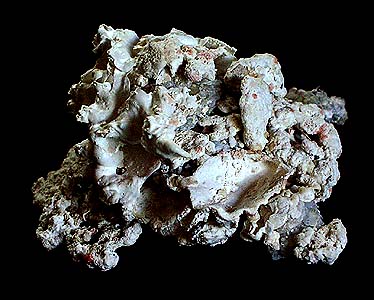
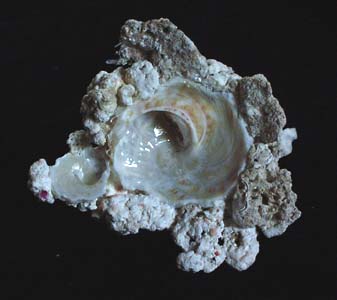
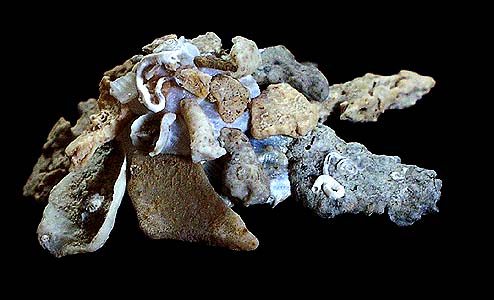
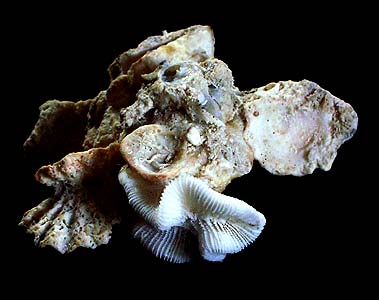
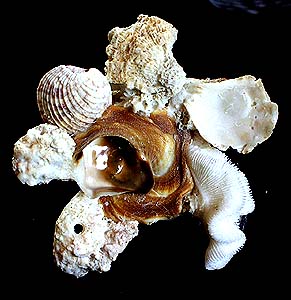
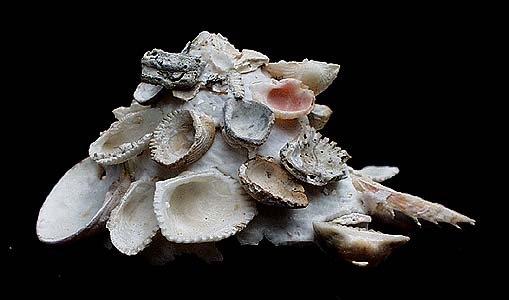
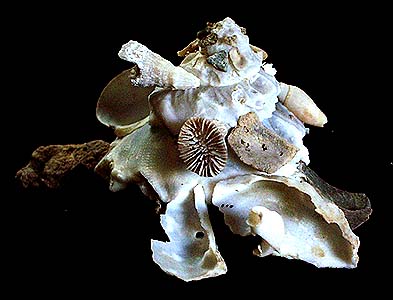
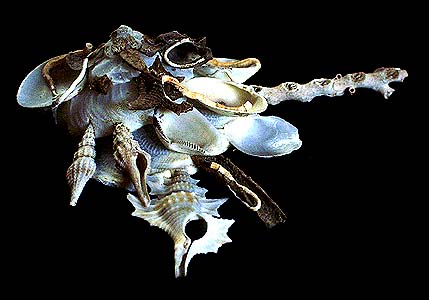
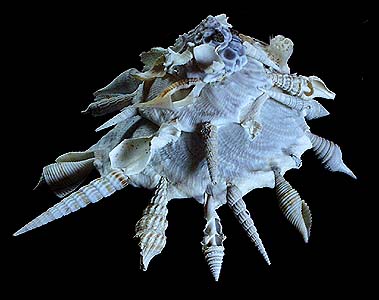
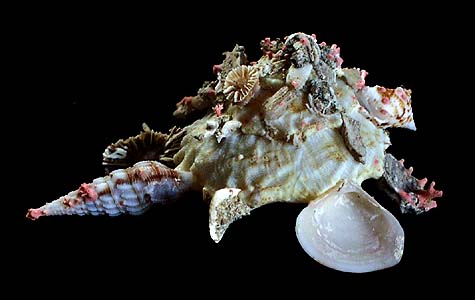
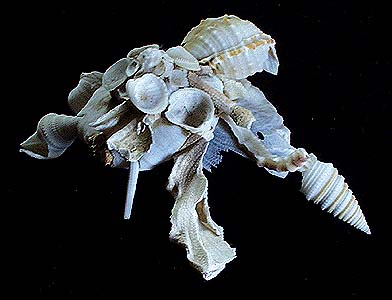
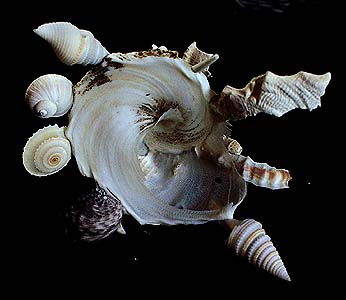
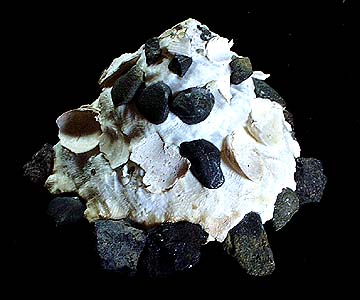
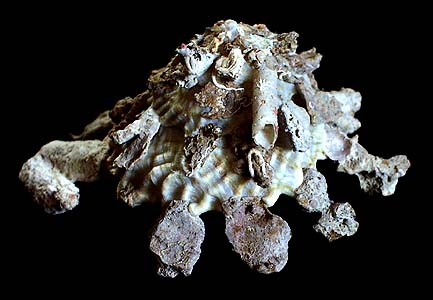
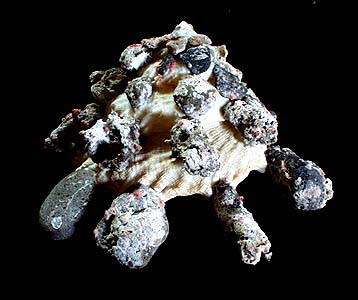
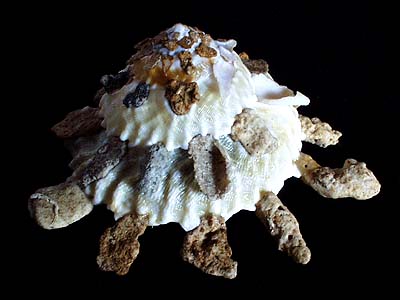
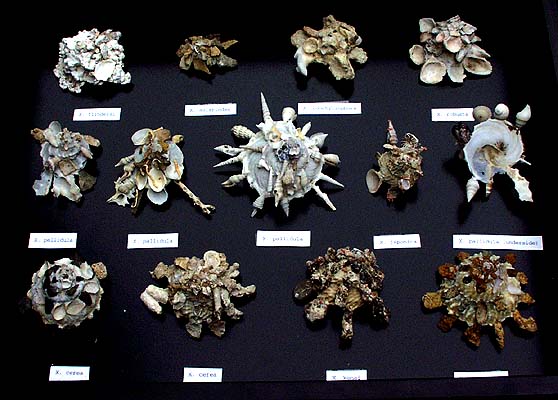
Marine snails of the genus Xenophora collect shells, rocks, and other debris from their environment. They attach these objects to their shells at intervals during the shell's growth. Sometimes it creates a neat radiating pattern; sometimes the effect is more that of a jumble of debris. The result for us in any case is that their collections become little samplings of a variety of faraway underwater realms.
| ||||||
| Top row: | X. flindersi | X. solarioides | X. conchyliophora | X. robusta | ||
| Middle row: | X. pallidula | X. pallidula | X. pallidula | X. japonica | X. pallidula (underside) | |
| Bottom row: | X. cerea | X. cerea | X. konoi | X. corrugata | ||
Natural History
It is not known to what extent an artistic sensibility plays a part in this behavior. The snails who live in shallower water (where there is enough light for them to be seen) probably use their collections for camouflage. The ones that live in the deeper, dark waters, such as X. pallidula, are believed to be motivated more by a desire to not to be sucked into the viscous muck in which they live. Attaching extensions to their shells spreads out the shell's surface area and helps prevent the animal from sinking. The additions may also strengthen the snail's relatively thin shell.
"Characteristically, the shell is covered with other shells, shell fragments, coral pieces, or stones that are attached or cemented with secretions from the animal. The shells are attached dead, although there is one account of a live kitten's paw being attached in an aquarium. All bivalves and bivalve pieces are attached inner side up and gastropods are usually attached with the aperture up. Once an object is selected, it is cleaned (as is the site of intended attachment), and then the object is rotated and fitted to the attachment site. This may take up to 1 1/2 hours. The piece is then held in place with the animal's foot, snout, and tentacle bases and glued into place. The Xenophora may then lay motionless for up to 10 hours, only rocking in place now and then, seemingly a check on the strength of its new attachment."
 From the (now extinct) Xenophoridae home page (retrieved Aug 30, 2009).
The "kitten's paw" referred to is actually a species of bivalve and the source of the tale is here
From the (now extinct) Xenophoridae home page (retrieved Aug 30, 2009).
The "kitten's paw" referred to is actually a species of bivalve and the source of the tale is here
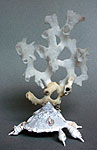
Not all of the items on a Xenophora's shell are put there by the creature itself. As a solid substrate in a mucky environment, the shell is an enticing landing spot for tube worms, oysters, and, most spectacularly, glass sponges. Their new home even has the advantage of being mobile, transporting a rooted animal to new feeding grounds.
Cultural significance
 During the Rust Age, Xenophora were valued for their mystical connections as "messengers from the deep." During the Age of Wonder, their collections were seen as little samplings of a variety of faraway underwater realms, a sort of natural curiosity cabinet. It was in the Modern Age that they acquired the nickname "assemblage artists of the deep."
This collection was on display at the Peninsula Art Museum as part of their "Obsessions" show (on collectors and their collections) as a collection of collectors. It was also featured in the (now extinct) Proceedings of the Athanasius Kircher Society on May 17th, 2006
Further reading
Up Close and Personal With the World?s Most Artistic Mollusks Atlas Obscura article on the museum's Xenophora collection. April 2017
Xenophoridae of the World: A Revision of the Recent Xenophoridae of the World and of the Australian Fossil Species (1983) W.F. Ponder, The Australian Museum. This obscure volume is, as its author states, "the only comprehensive review of the family in 100 years."
Recent Xenophoridae (1999) Kurl Kreipl and Axel Alf, ConchBooks. A somewhat less technically oriented publication for the serious shell collector
Other "assemblage artist" animals:
- Caddis fly larvae attach small bits of detritus to themselves as camouflage and protection
- Decorator crabs sport entire undersea gardens of sessile animals
- Male bowerbirds decorate their bachelor pads with shells, bones, and shiny objects to attract females.